Note
Go to the end to download the full example code.
MMV with non-negative norms
In this tutorial we will use the spg_mmv solver, which solves a
multi-measurement vector basis pursuit denoise problem. Both the standard L12
and L12non-negative norms will be compared. The latter set of norms is used if we
want our solution to have only positive values in case we have access to
such a kind of prior information.
import matplotlib.pyplot as plt
import numpy as np

import spgl1
Let’s first import our data, matrix operator and weights
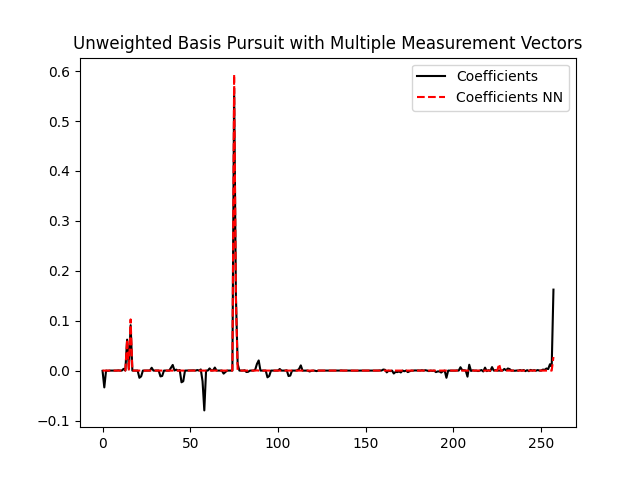
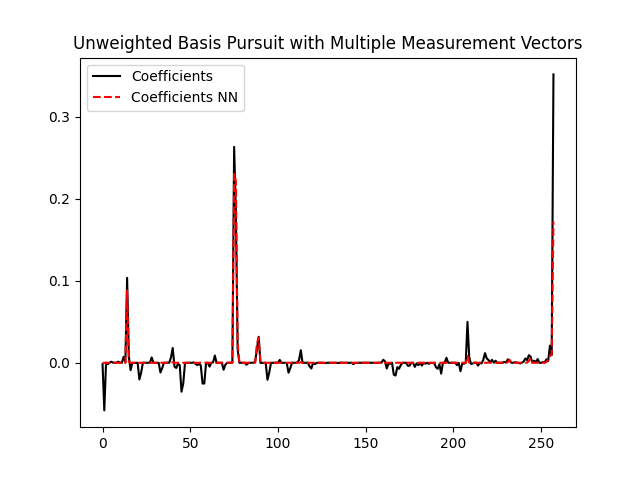
We apply unweighted inversions with and without non-negative norms.
X, _, _, info = spgl1.spg_mmv(A, B, 0.5, iter_lim=100, verbosity=0)

XNN, _, _, infoNN = spgl1.spg_mmv(
    A,
    B,
    0.5,
    iter_lim=100,
    verbosity=0,
    project=spgl1.norm_l12nn_project,
    primal_norm=spgl1.norm_l12nn_primal,
    dual_norm=spgl1.norm_l12nn_dual,
)
print("Negative X - MMV:", np.any(X < 0))
print("Negative X - MMVNN:", np.any(XNN < 0))
print("Residual norm - MMV:", info["rnorm"])
print("Residual norm - MMVNN:", infoNN["rnorm"])

plt.figure()
plt.plot(X[:, 0], "k", label="Coefficients")
plt.plot(XNN[:, 0], "--r", label="Coefficients NN")
plt.legend()
plt.title("Unweighted Basis Pursuit with Multiple Measurement Vectors")

plt.figure()
plt.plot(X[:, 1], "k", label="Coefficients")
plt.plot(XNN[:, 1], "--r", label="Coefficients NN")
plt.legend()
plt.title("Unweighted Basis Pursuit with Multiple Measurement Vectors")
/home/docs/checkouts/readthedocs.org/user_builds/spgl1/checkouts/latest/spgl1/spgl1.py:363: RuntimeWarning: invalid value encountered in divide
  xc = xc / xa
Negative X - MMV: True
Negative X - MMVNN: False
Residual norm - MMV: 1.3845145951758175
Residual norm - MMVNN: 1.8882592382476573

Text(0.5, 1.0, 'Unweighted Basis Pursuit with Multiple Measurement Vectors')
We repeat the same steps with weighted norms.
X, _, _, info = spgl1.spg_mmv(
    A, B, 0.5, iter_lim=100, weights=np.array(weights), verbosity=0
)
XNN, _, _, infoNN = spgl1.spg_mmv(
    A,
    B,
    0.5,
    iter_lim=100,
    verbosity=0,
    weights=np.array(weights),
    project=spgl1.norm_l12nn_project,
    primal_norm=spgl1.norm_l12nn_primal,
    dual_norm=spgl1.norm_l12nn_dual,
)
print("Negative X - MMV:", np.any(X < 0))
print("Negative X - MMVNN:", np.any(XNN < 0))
print("Residual norm - MMV:", info["rnorm"])
print("Residual norm - MMVNN:", infoNN["rnorm"])

plt.figure()
plt.plot(X[:, 0], "k", label="Coefficients")
plt.plot(XNN[:, 0], "--r", label="Coefficients NN")
plt.legend()
plt.title("Weighted Basis Pursuit with Multiple Measurement Vectors")

plt.figure()
plt.plot(X[:, 1], "k", label="Coefficients")
plt.plot(XNN[:, 1], "--r", label="Coefficients NN")
plt.legend()
plt.title("Weighted Basis Pursuit with Multiple Measurement Vectors")
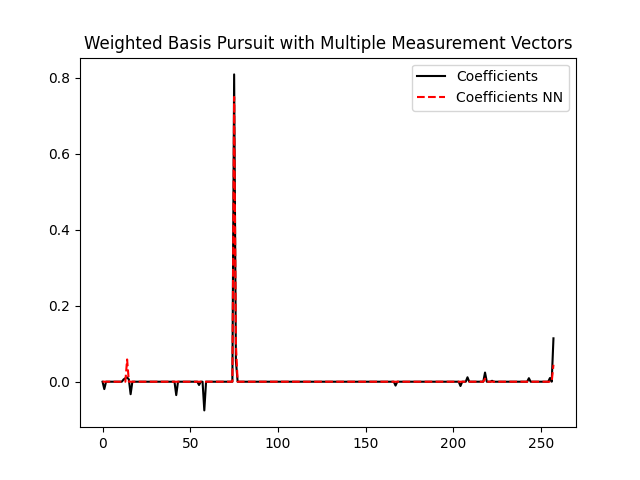
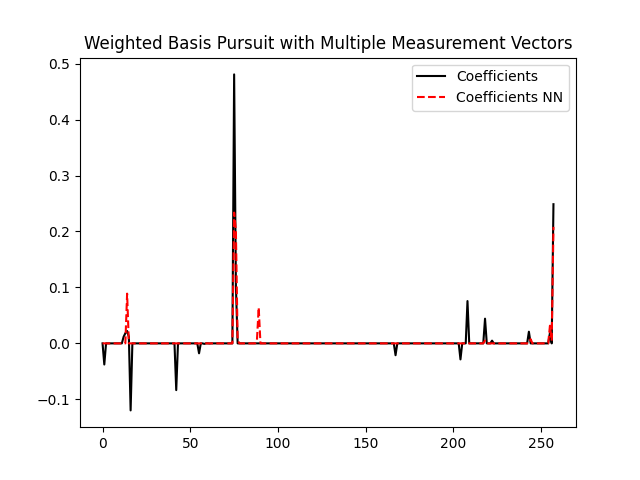
Negative X - MMV: True
Negative X - MMVNN: False
Residual norm - MMV: 1.5813724036787324
Residual norm - MMVNN: 1.8187503062325858

Text(0.5, 1.0, 'Weighted Basis Pursuit with Multiple Measurement Vectors')
Total running time of the script: (0 minutes 0.753 seconds)